JavaScript Runtime with deno_core
- Main Content
- Prerequisites
- Creating the Project
- Dependencies
- Hello, runjs!
- Adding the Console API
- Adding File System APIs
- Summary
If you’re not familiar with Deno, check out the official website at https://deno.land/. In short, Deno is a more secure alternative to Node (the name is literally Node reversed: no_de -> de_no), created by the same founder as Node.
A couple of days ago, the Deno blog published an article titled “Roll your own JavaScript runtime”
https://deno.com/blog/roll-your-own-javascript-runtime

I was inspired to write this learning note after reading the article. Note: This is not a word-for-word translation, but rather a learning record with minor modifications while preserving the original meaning. The “inspiration” came from the fact that about six months ago, I looked at Deno’s documentation on Embedding Deno (https://deno.land/manual/embedding_deno), but it didn’t have much content—it just pointed to the deno_core documentation (https://crates.io/crates/deno_core) without any getting started tutorial. At the time, my Rust skills weren’t strong enough, so I didn’t continue exploring.
Without further ado, let’s get started.
Main Content
This article explains how to create a custom JavaScript runtime called runjs. Think of it as a very simple version of Deno. The goal is to develop a command-line program that can execute local JavaScript files, with the ability to read, write, and delete files, plus a console API.
Let’s begin.
Prerequisites
This tutorial assumes you have knowledge of:
- Basic Rust
- Basic understanding of JavaScript event loops
Make sure you have Rust installed (cargo is automatically installed with Rust) with version 1.62.0 or higher. Visit https://www.rust-lang.org/learn/get-started to install it.
$ cargo --version
cargo 1.62.0 (a748cf5a3 2022-06-08)
Creating the Project
First, let’s create a new Rust project called runjs:
$ cargo new runjs
     Created binary (application) package
Navigate to the runjs folder and open it in your editor. Make sure everything works:
$ cd runjs
$ cargo run
   Compiling runjs v0.1.0 (/Users/ib/dev/runjs)
    Finished dev [unoptimized + debuginfo] target(s) in 1.76s
     Running `target/debug/runjs`
Hello, world!
Perfect! Now let’s start building our own JavaScript runtime.
Dependencies
Next, add the dependencies deno_core and tokio:
$ cargo add deno_core
    Updating crates.io index
      Adding deno_core v0.142.0 to dependencies.
$ cargo add tokio --features=full
    Updating crates.io index
      Adding tokio v1.19.2 to dependencies.
Your Cargo.toml file should now look like this:
[package]
name = "runjs"
version = "0.1.0"
edition = "2021"

# See more keys and their definitions at https://doc.rust-lang.org/cargo/reference/manifest.html

[dependencies]
deno_core = "0.142.0"
tokio = { version = "1.19.2", features = ["full"] }
deno_core is a Rust crate developed by the Deno team that abstracts the V8 JavaScript engine interface. V8 is a complex project with many APIs. To make V8 easier to use, deno_core provides the JsRuntime struct, which wraps a V8 engine instance (also called an Isolate) and supports event loops.
tokio is an asynchronous Rust runtime that we’ll use to implement the event loop. Tokio can interact with system sockets and the file system. Together, deno_core and tokio enable mapping JavaScript Promises to Rust Futures (i.e., JS async/await maps to Rust async/await).
With a JavaScript engine and an event loop, we can create a JavaScript runtime.
Hello, runjs!
Now let’s write an async Rust function that creates a JsRuntime instance for executing JavaScript:
// main.rs
use std::rc::Rc;
use deno_core::error::AnyError;

async fn run_js(file_path: &str) -> Result<(), AnyError> {
  let main_module = deno_core::resolve_path(file_path)?;
  let mut js_runtime = deno_core::JsRuntime::new(deno_core::RuntimeOptions {
      module_loader: Some(Rc::new(deno_core::FsModuleLoader)),
      ..Default::default()
  });

  let mod_id = js_runtime.load_main_module(&main_module, None).await?;
  let result = js_runtime.mod_evaluate(mod_id);
  js_runtime.run_event_loop(false).await?;
  result.await?
}

fn main() {
  println!("Hello, world!");
}
There’s a lot to unpack here. The async run_js function creates a JsRuntime instance that uses a file system-based module loader (deno_core::FsModuleLoader). Then, we load a module (main_module) with js_runtime, evaluate it (mod_evaluate), and run an event loop (run_event_loop).
The run_js function encompasses the entire lifecycle of JavaScript code execution. But first, we need to create a single-threaded tokio runtime to execute the run_js function:
// main.rs
fn main() {
  let runtime = tokio::runtime::Builder::new_current_thread()
    .enable_all()
    .build()
    .unwrap();
  if let Err(error) = runtime.block_on(run_js("./example.js")) {
    eprintln!("error: {}", error);
  }
}
Let’s execute some JavaScript code. Create an example.js file that outputs “Hello runjs!”:
// example.js
Deno.core.print("Hello runjs!");
Note:
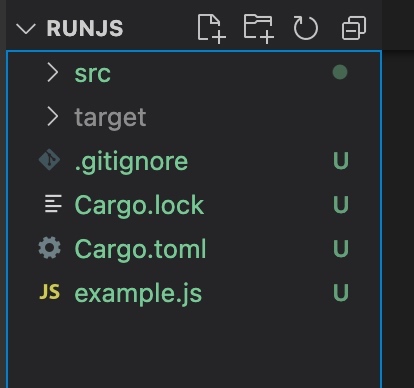
example.jsis in the project root folder.cargo runuses the root folder as the working directory.
Note that we’re using the print function from Deno.core. Deno.core is a globally available built-in object provided by deno_core.
Now let’s run it:
$ cargo run
    Finished dev [unoptimized + debuginfo] target(s) in 0.05s
     Running `target/debug/runjs`
Hello runjs!⏎
Success! We’ve created a simple JavaScript runtime that can execute local files with just 25 lines of code. Of course, this runtime can’t do much yet (for example, it doesn’t support console.log). We’ve now integrated the V8 JavaScript engine and tokio into our project.
Adding the Console API
Let’s implement the console API. First, create a src/runtime.js file that implements the global console object:
// src/runtime.js
((globalThis) => {
  const core = Deno.core;

  function argsToMessage(...args) {
    return args.map((arg) => JSON.stringify(arg)).join(" ");
  }

  globalThis.console = {
    log: (...args) => {
      core.print(`[out]: ${argsToMessage(...args)}\n`, false);
    },
    error: (...args) => {
      core.print(`[err]: ${argsToMessage(...args)}\n`, true);
    },
  };
})(globalThis);
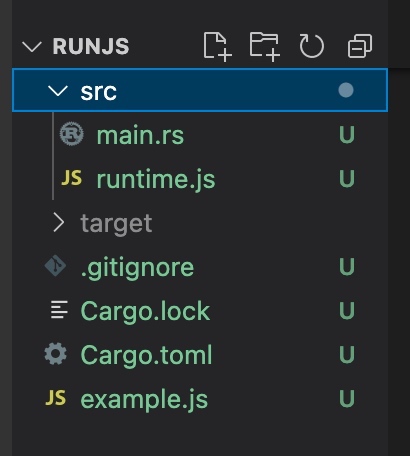
Note: This
runtime.jsfile is in thesrcfolder.
The console.log and console.error functions can accept multiple arguments, serialize them to JSON (so we can view non-native JS objects), and prefix each message with “log” or “error”. This is a somewhat “old-school” JavaScript file, like writing JavaScript in the browser before ES modules existed.
We use an IIFE to execute the code to avoid polluting the global scope. Otherwise, the argsToMessage helper function would be globally available in our runtime.
Now let’s execute this code every time we run:
let mut js_runtime = deno_core::JsRuntime::new(deno_core::RuntimeOptions {
  module_loader: Some(Rc::new(deno_core::FsModuleLoader)),
  ..Default::default()
});
+ js_runtime.execute_script("[runjs:runtime.js]",  include_str!("./runtime.js")).unwrap();
Note:
include_str!reads the contents ofruntime.jsfrom the same directory asmain.rs(i.e., thesrcdirectory).
Finally, we can call the new console API in example.js:
- Deno.core.print("Hello runjs!");
+ console.log("Hello", "runjs!");
+ console.error("Boom!");
Run it:
$ cargo run
    Finished dev [unoptimized + debuginfo] target(s) in 0.05s
     Running `target/debug/runjs`
[out]: "Hello" "runjs!"
[err]: "Boom!"
Adding File System APIs
First, update the runtime.js file:
};

+ globalThis.runjs = {
+   readFile: (path) => {
+     return core.opAsync("op_read_file", path);
+   },
+   writeFile: (path, contents) => {
+     return core.opAsync("op_write_file", path, contents);
+   },
+   removeFile: (path) => {
+     return core.opSync("op_remove_file", path);
+   },
+ };

})(globalThis);
We’ve added a new global object runjs with three methods: readFile, writeFile, and removeFile. The first two are async, and the last one is synchronous.
You might be wondering what core.opAsync and core.opSync are. They’re mechanisms provided by deno_core to bind JavaScript and Rust functions. When called from JavaScript, deno_core will look for a Rust function with the same name marked with the #[op] attribute.
Let’s update main.rs to see it in action:
+ use deno_core::op;
+ use deno_core::Extension;
use deno_core::error::AnyError;
use std::rc::Rc;

+ #[op]
+ async fn op_read_file(path: String) -> Result<String, AnyError> {
+     let contents = tokio::fs::read_to_string(path).await?;
+     Ok(contents)
+ }
+
+ #[op]
+ async fn op_write_file(path: String, contents: String) -> Result<(), AnyError> {
+     tokio::fs::write(path, contents).await?;
+     Ok(())
+ }
+
+ #[op]
+ fn op_remove_file(path: String) -> Result<(), AnyError> {
+     std::fs::remove_file(path)?;
+     Ok(())
+ }
We’ve defined three ops that JavaScript can call, but to make them available to JavaScript code, we need to register an extension with JsRuntime:
async fn run_js(file_path: &str) -> Result<(), AnyError> {
    let main_module = deno_core::resolve_path(file_path)?;
+    let runjs_extension = Extension::builder()
+        .ops(vec![
+            op_read_file::decl(),
+            op_write_file::decl(),
+            op_remove_file::decl(),
+        ])
+        .build();
    let mut js_runtime = deno_core::JsRuntime::new(deno_core::RuntimeOptions {
        module_loader: Some(Rc::new(deno_core::FsModuleLoader)),
+        extensions: vec![runjs_extension],
        ..Default::default()
    });
We can configure JsRuntime with Extensions to expose Rust functions to JavaScript, and do more advanced things (like loading additional JavaScript code).
Update example.js again:
console.log("Hello", "runjs!");
console.error("Boom!");
+
+ const path = "./log.txt";
+ try {
+   const contents = await runjs.readFile(path);
+   console.log("Read from a file", contents);
+ } catch (err) {
+   console.error("Unable to read file", path, err);
+ }
+
+ await runjs.writeFile(path, "I can write to a file.");
+ const contents = await runjs.readFile(path);
+ console.log("Read from a file", path, "contents:", contents);
+ console.log("Removing file", path);
+ runjs.removeFile(path);
+ console.log("File removed");
+
Run it:
$ cargo run
   Compiling runjs v0.1.0 (/Users/ib/dev/runjs)
    Finished dev [unoptimized + debuginfo] target(s) in 0.97s
     Running `target/debug/runjs`
[out]: "Hello" "runjs!"
[err]: "Boom!"
[err]: "Unable to read file" "./log.txt" {"code":"ENOENT"}
[out]: "Read from a file" "./log.txt" "contents:" "I can write to a file."
[out]: "Removing file" "./log.txt"
[out]: "File removed"
🎉 Congratulations! Our runjs runtime now supports the file system. Notice how we implemented JavaScript calling Rust code with very little code: deno_core handles all the communication between JavaScript and Rust.
Summary
In this brief example, we’ve implemented a Rust project that integrates a powerful JavaScript engine (V8) with an efficient event loop (tokio).
For the complete example code, check out denoland’s GitHub:
https://github.com/denoland/roll-your-own-javascript-runtime